

Alloy Wheel Blog | Industry Insights & B2B Sourcing Guides | Holywheel
Custom Forged Wheel RFQ: A Checklist for Dealers


A custom forged wheel RFQ needs to tell the supplier the intended vehicle or application, wheel specifications, quantities by specification, finish preferences and delivery destination. Identify your business and mark any unverified fitment values as “to be confirmed.”
An RFQ, or request for quotation, is the document that opens the conversation. It gives the supplier a defined project to review and helps you compare the scope of different offers. A quoted price alone does not confirm vehicle fitment or approve a design for production.
This checklist is for distributors, importers and wheel shops preparing a custom order. It includes a specification table, a copyable email template and the confirmations to request before committing to production.
What to include in your custom forged wheel RFQ
Organize the first message into these groups:
| Information group | What to send | What to flag for review |
|---|---|---|
| Business and application | Company, country, buyer role and intended use | Whether this is a customer project, sample evaluation or resale order |
| Vehicle details | Model year, make, model, trim and relevant modifications | Brake package, suspension changes and missing application data |
| Wheel specifications | A separate line for each wheel configuration | Any target dimension that has not been checked |
| Quantity | Pieces per configuration and position | Spares, front/rear splits and repeat-order requirements |
| Design and finish | Design reference, finish description and requested branding | Reference-image rights, color approval and available options |
| Commercial requirements | Destination, requested delivery window and quote scope | Packing, accessories, documents and transport responsibilities |
You do not need to guess every dimension before contacting a supplier. A gap you have flagged is more useful than an unsupported value that looks final.
Describe the vehicle and the application
Give enough information to distinguish the actual application: model year, make, model and trim, plus the market version where relevant. Add the intended use and any changes to brakes, suspension or bodywork that could affect the wheel selection.
When the order is for a specific customer vehicle, say whether you are supplying a verified fitment specification or asking the supplier to review proposed dimensions. For inventory buying, name the applications you intend to cover and ask what evidence supports each proposed fitment. A broad description such as “for SUVs” leaves that question unresolved.
Keep existing wheel measurements, proposed replacement dimensions and vehicle requirements in separate fields. An existing wheel can be a useful reference, but its dimensions should not silently become the specification for a different design.
For an example of the information involved, Boyd Coddington Wheels’ custom wheel order form separates front and rear measurements and asks for hub, brake and caliper-clearance details. Follow the reviewing supplier’s measurement instructions; use the template below to organize your inquiry rather than treating it as a fitment approval form.
Give every wheel configuration its own quote line
Use a separate line whenever the diameter, width, fitment, finish or other order-defining detail changes. Label front and rear configurations explicitly, and state quantities in pieces. If you also describe the order in sets, show what each set contains.
| RFQ field | What to record |
|---|---|
| Line reference | Your own reference for this exact configuration |
| Wheel position | Front, rear or another clearly identified application |
| Design reference | Confirmed model or drawing reference; list reference images separately for design discussion |
| Construction requested | Your preferred wheel construction, subject to availability and technical review |
| Diameter and width | Dimensions with units and the width measurement reference |
| Bolt pattern / PCD | Bolt-hole count and pitch-circle diameter |
| Offset / ET | Value, positive or negative sign, and unit |
| Center bore | Required diameter with unit, or an explicit request for review |
| Application and load information | Verified requirements or supporting vehicle documentation |
| Finish and accessories | Finish reference, cap request and items to include in the quote |
| Quantity | Number of pieces for this line, including any spares |
| Confirmation status | Buyer target, under technical review or agreed specification |
For each proposed fitment, record the source of its values and the date: vehicle documentation, a measured reference or a written supplier proposal. Keep any agreed specification reference separate from the original request, and ask which measurements or documents still need review.
Use the supplier’s specification terminology consistently. KMC’s wheel specification guide explains bolt pattern, offset and backspacing. If your inquiry uses both offset and backspacing, identify the wheel width and measurement reference too; our offset and backspacing guide explains their relationship.
For load requirements, attach the relevant vehicle or application information and identify the proposed wheel specification. Ask the technical reviewer to confirm suitability. Do not fill an unknown load value from a generic vehicle category or assume a value applies to every size in a wheel design.
Separate design references from approved specifications
A reference photo communicates a visual direction. Say what you want to discuss: spoke style, face profile, finish or another visible feature. Ask the supplier to identify the proposed design and its specification, rather than using the photo as the only order description.
Use one confirmed model or drawing reference throughout the quotation, approvals, labels and order sheet. Clear up any conflicting identifiers, then approve the order.
For your own logo, center-cap artwork or packaging design, explain the request and verify that you have permission to use the artwork. Ask which options can be supplied and what approval steps they require. A branding request in an RFQ is not confirmation that every option is available.
Describe the finish in words and attach a reference. Where color matching matters, agree the approval method before production; an image on a screen should not be the sole acceptance reference. Ask the quotation to state the agreed finish and any exclusions.
Make the commercial scope clear
Provide the destination country and city, with the port or delivery address needed for the quotation you are requesting. Give your desired delivery window and distinguish the date the goods need to be ready from the date you need them to arrive.
Ask the supplier to specify:
- The quantity and unit used for each quoted line.
- What is included for caps, fitting hardware, packaging and labeling.
- Any separate design, sample or development charges that apply.
- The quoted trade term and named place or port.
- Payment terms, quotation validity and the conditions behind the proposed schedule.
- The documents, inspection records and acceptance requirements agreed for the order.
Ask the supplier to state the scope of each quoted line. Compare totals only after differences in accessories, packaging and delivery responsibilities are settled. Our wholesale wheel quote checklist gives you a structure for that comparison.
Keep inquiry, review and production approval separate
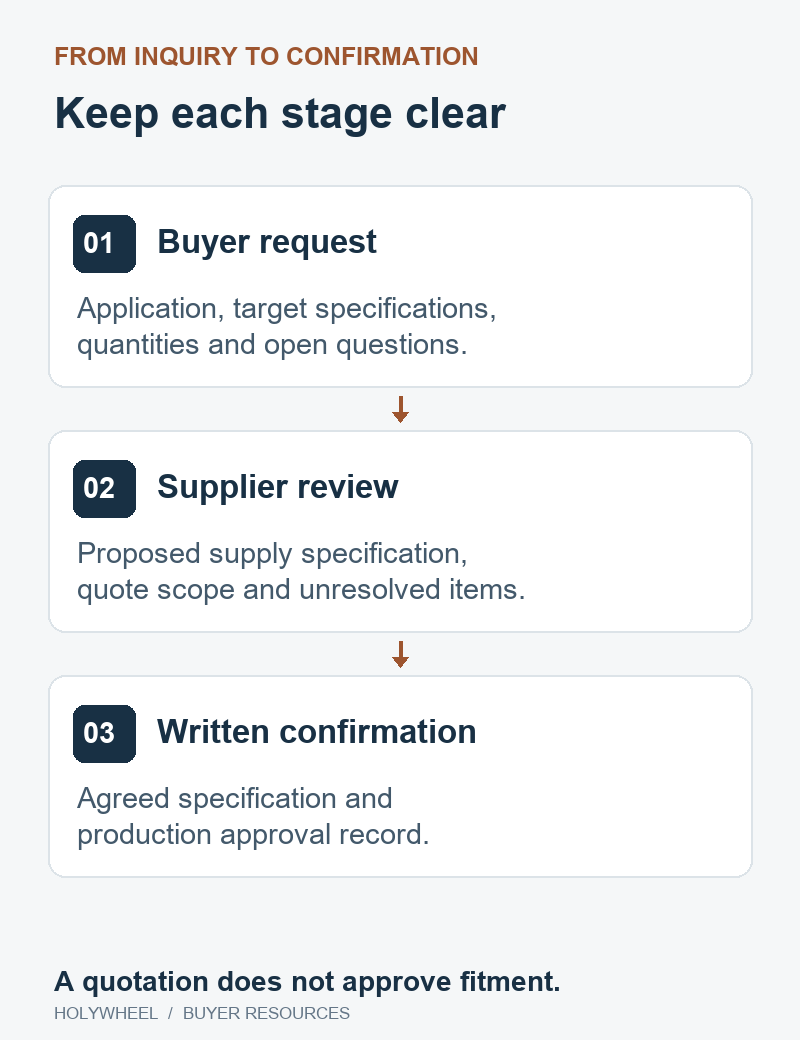
Give each specification a clear status as the discussion progresses:
- Buyer’s request: proposed dimensions, preferences, quantities and open questions.
- Supplier review: the proposed supply specification, commercial scope and items still requiring confirmation.
- Production confirmation: the written specification and approval record the parties agree to use for the order.
Keep the quotation, specification sheet and approval drawing filed together under their reference and date. Agree in advance how changes will be recorded and reapproved.
Before authorizing production, resolve the open items and confirm who is responsible for technical fitment review. A quotation, a visual rendering and an approved technical specification serve different purposes; record which documents have actually been accepted.
Copy this custom forged wheel RFQ template
Use this as an inquiry email. Repeat the wheel-line block for each configuration. Leave unknown technical values marked “to be confirmed.”
Subject: Custom forged wheel RFQ — [company / project reference]

BUSINESS AND PROJECT
RFQ reference / revision / date:
Company / website:
Contact name and email:
Country / city:
Buyer role: distributor / importer / wheel shop / other
Project: customer order / sample evaluation / resale inventory
Vehicle or target application:
Model year / make / model / trim / market version:
Intended use:
Brake, suspension and body modifications:
Supporting vehicle information attached:

WHEEL LINE — repeat for each configuration
Our line reference:
Position / application:
Confirmed model or drawing reference:
Reference images for design discussion:
Preferred construction — availability to be confirmed:
Diameter and width / units / measurement reference:
Bolt pattern / PCD:
Offset / ET — include sign and unit:
Center bore / unit:
Load requirement or supporting application document:
Target values / source / date:
Fitment review status / open items:
Approved reference / revision — if already agreed:
Finish reference:
Caps, hardware or branding requested:
Quantity in pieces — identify spares:
Open technical questions:

QUOTATION SCOPE
Destination country / city / port or delivery address:
Trade term / named place requested — supplier acceptance to be confirmed:
Desired ready date / arrival requirement:
Packaging and label requirements:
Documents and inspection requirements:
Please identify included items, separate charges,
payment terms, quotation validity and schedule conditions.

Please list any assumptions and items requiring technical
review. Confirm the proposed specification and approval
steps before we authorize production.
Avoid combining several configurations under one total quantity. Keeping a line reference makes it easier to connect each quoted price, approval and delivered item to the same specification.
RFQ questions for dealers
Can I request a quote before all fitment values are confirmed?
Yes — describe it as a preliminary inquiry, list what is known and ask what additional information is required. Request that assumptions and unresolved items are shown in the response. Do not treat a preliminary price as approval of those unknowns.
Is a photo enough to order the same wheel?
Use it as a reference for discussion and ask for a confirmed design or model identifier. Record the proposed dimensions and finish separately. Check the image, model name and order specification against each other, and approve the order only once they match.
Should front and rear wheels be on separate lines?
Use separate lines whenever their specifications differ. State the position, quantity in pieces and any spares for each line, then explain how those lines make up the sets you plan to sell.
What should I ask for after receiving a quotation?
Check that it answers every RFQ line, names its assumptions and defines what is included. Settle the technical questions, agree the specification, acceptance requirements and production approval record, then proceed.
Prepare your next custom forged wheel RFQ
Review Holywheel’s custom alloy wheel options, then use the template to prepare your project details. Forged wheels carry an MOQ of 4 pcs for both in-stock and custom-made orders, so a first order does not have to be large. Email the completed template to info@holywheel.com. You can also use our Contact page to send a short project summary and ask how to share the full specification sheet and supporting files.
Identify the information that is confirmed and the questions that still need review. That gives both parties a clear starting point for a quotation and the technical discussion that follows.