


Alloy Wheel Blog | Industry Insights & B2B Sourcing Guides | Holywheel
Alloy Wheel Size Guide: 17 vs 18 vs 19 vs 20 Inch (2026)

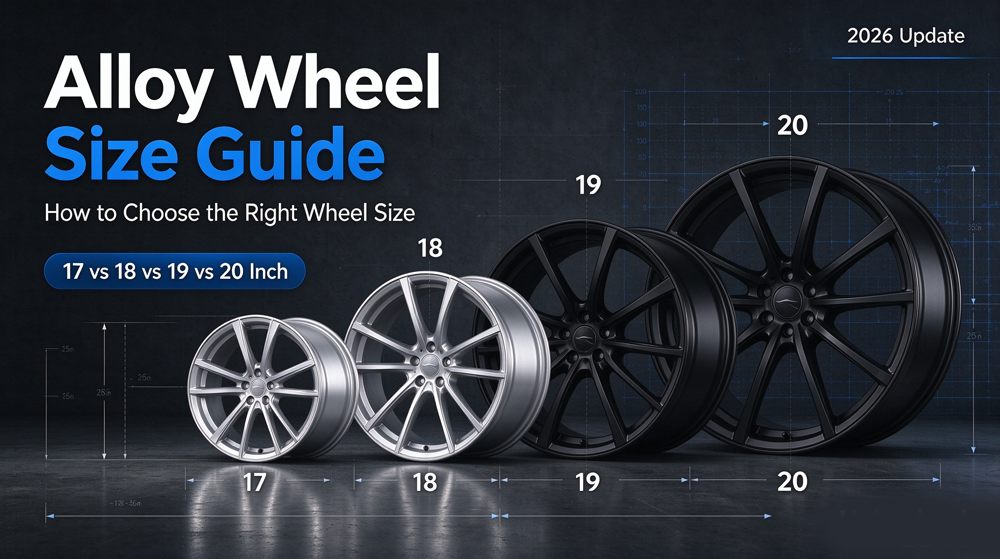
Alloy Wheel Size Guide: How to Choose the Right Wheel Size — 17 vs 18 vs 19 vs 20 Inch (2026)
By the HolyWheel team — 20 years shipping alloy wheels to 30+ countries
I’ve been in this game for a long time, and this alloy wheel size guide is the distillation of everything I’ve learned. I’ve watched shops pour money into the wrong wheel sizes — thousands of dollars sitting on shelves, gathering dust, while customers walk in asking for something they don’t have.
Here’s the truth: wheel size is, in fact, the single biggest inventory decision you’ll make. Get it right, your stock moves fast and your cash flow stays healthy. Get it wrong, you’re stuck with dead inventory for months.
So here’s what I’ll cover in this alloy wheel size guide: the four most common sizes — 17, 18, 19, and 20 inches — who buys what, where, and why. Whether you’re stocking 17 inch wheels wholesale for a fleet deal or going after the premium 20 inch wheel market, this breakdown will point you in the right direction.
Quick Tip: Before you order, always cross-reference the most popular vehicle models in your target market. Sites like wheel-size.com maintain a free database of OEM wheel sizes by make, model, and year — it takes five minutes and can save you from stocking the wrong size for an entire market.
17 Inch Wheels: The Bread-and-Butter Size
Shop 17 inch wheels wholesale →
If I had to pick one size that moves consistently — and this is a key takeaway from this alloy wheel size guide — in almost every market, it’s the 17-inch. These are the workhorses. They fit a massive range of vehicles — economy sedans, compact crossovers, taxis, rental fleet vehicles, and entry-level SUVs.
Who Buys 17 Inch Wheels Wholesale?
- Rental and fleet operators — Affordable and durable. Price per unit matters more than flash.
- Economy car owners — Corolla, Civic, Elantra owners upgrading from 15- or 16-inch stock wheels for a sportier look.
- Ride-hailing drivers — In Southeast Asia and Latin America, 17-inch machined-face wheels are a hot seller for MPVs and compact cars.
Pros
- Lower unit cost — More affordable to stock in bulk, which means lower risk if something doesn’t sell.
- High compatibility — Fits a wider range of vehicles than larger sizes.
- Faster turnover — Because the price point is accessible, these move quickly in most markets.
- Good tire sidewall — Customers in markets with rough roads (parts of Africa, Southeast Asia, South America) appreciate the extra cushion.
Cons
- Lower profit per unit — You’re working on thinner margins. You make it up on volume.
- Less visual impact — Enthusiast customers often want bigger.
Bottom line: Every shop should have 17-inch inventory. In Southeast Asia and Brazil, the 15-to-17-inch range accounts for the majority of walk-in sales.
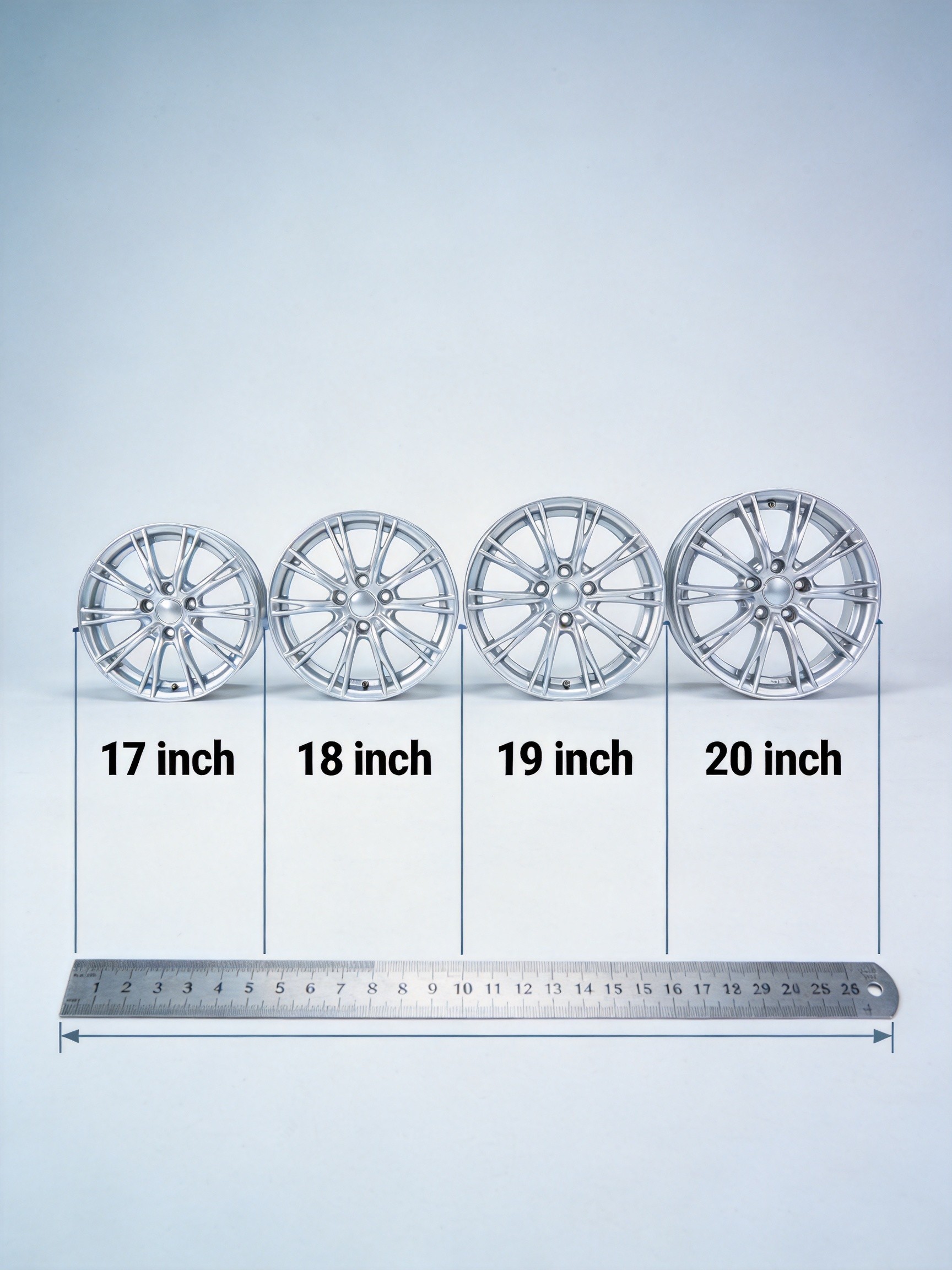
18 Inch Wheels: The Sweet Spot
The 18-inch sits right in the middle — big enough to look aggressive, small enough to be practical. Mainstream car owners are upgrading to this size, and it’s increasingly the OEM standard on mid-trim vehicles.
Who Buys 18 Inch Wheels Bulk?
- Mid-range sedan and SUV owners — Accord, Camry, CX-5, Tiguan. The aftermarket upgrade demand is huge.
- General retail customers — “Something that looks good but isn’t crazy” — point them to 18s.
- European market shops — 18-inch is the most popular aftermarket upgrade size in Europe.
Pros
- Highest demand across the broadest customer base — It’s the “safe bet” size.
- Great profit margin — Higher perceived value than 17-inch, but not so big that tire costs scare customers away.
- Deep concave designs shine here — A machined-face 18-inch with deep concave profile moves fast anywhere. Visual impact meets practicality.
- OEM trend is moving this way — More new cars come stock with 18s, so the replacement cycle is just getting started.
Cons
- More competition — Because it’s the sweet spot, every supplier is fighting for this segment. Your style selection and pricing need to be sharp.
- Requires more PCD/offset variety — You’ll need to carry multiple bolt patterns to cover European, Japanese, and American vehicles.
Bottom line: If you’re only going to bet big on one size, make it 18. Best combination of demand, margin, and versatility.
19 Inch Wheels: The Premium Play
Now we’re in premium territory. The 19-inch is where enthusiast customers, luxury car clients, and high-margin sales live.
Who Buys 19 Inch Wheels?
- Luxury car owners — BMW 5 Series, Mercedes E-Class, Audi A6, Lexus. Owners love to upgrade to more aggressive aftermarket designs.
- Performance enthusiasts — Track-day guys, stance builders, anyone who cares about filling out their wheel wells.
- Middle East and North America — In the UAE, the 19-22 inch segment accounts for roughly 60% of aftermarket wheel demand in 2026.
Pros
- Higher profit per unit — Customers in this segment expect to pay more and they’re less price-sensitive.
- Strong demand in wealthy markets — UAE, Saudi Arabia, USA, Western Europe.
- Forged wheels shine here — A 19-inch forged with custom finish commands premium pricing.
- Less price competition — Not every shop stocks a deep 19-inch range.
Cons
- Slower turnover — These don’t fly off the shelf like 17s and 18s. You need patience and the right customer base.
- Tire costs climb — Customers start to hesitate when they realize a set of 19-inch performance tires costs more than the wheels.
- Narrower vehicle fitment — Fewer cars use 19-inch as stock, so your addressable market per design is smaller.
Bottom line: Shops in the Middle East, North America, and Western Europe need a solid 19-inch range. In the Gulf market, aim for at least 20-25% of inventory in the 19-22 inch range.
20 Inch Wheels: The Top of the Food Chain
The 20-inch wheel is where the big money lives — but only if you’re in the right market. These are for SUVs, pickups, and luxury vehicles that need serious presence.
Who Buys 20 Inch Wheels?
- SUV and pickup owners — F-150, Land Cruiser, Tahoe, Ram 1500. The 20-inch is the sweet spot for these trucks.
- Luxury SUV buyers — Range Rover, Porsche Cayenne, BMW X5, Mercedes GLE. They want commanding presence.
- Off-road enthusiasts — Markets where heavy-duty wheels with 1,800 kg+ load ratings are in demand.
Pros
- Highest profit per unit — A set of 20-inch forged wheels for a Land Cruiser or F-150 is a big-ticket sale.
- Strong demand in North America and the Middle East — 18- and 20-inch are the top aftermarket sizes for trucks. In Saudi Arabia, 17-22 inch heavy-duty SUV wheels are the core demand.
- Visual impact sells itself — Customer sees a 20-inch wheel on their truck, the sale is almost done.
Cons
- Smallest addressable market — Fewer vehicles use 20-inch stock, so your customer pool is narrower.
- Higher inventory cost — Each wheel costs more, so your capital is tied up longer.
- Requires specific fitments — 6-lug patterns for trucks, high load ratings, specific offsets for large SUVs.
Bottom line: A must-stock for US, Canada, Middle East, and Australia. For Southeast Asia or Africa shops, keep a small selection for luxury SUV customers.
Alloy Wheel Size Guide: Comparison Table (2026 Data)
Use this alloy wheel size guide to compare the key metrics at a glance:
| Size | Relative Price Level | Typical MOQ | Best-Fit Vehicles | Profit Margin | Turnover Speed |
|---|---|---|---|---|---|
| 17 inch | Lowest | 4–100 pcs | Corolla, Civic, Elantra, MPVs, taxis | ★★☆☆☆ | ★★★★★ |
| 18 inch | Moderate | 4–100 pcs | Accord, Camry, CX-5, Tiguan, mid-SUVs | ★★★☆☆ | ★★★★☆ |
| 19 inch | Higher | 4–50 pcs | BMW 5, Mercedes E, Audi A6, Lexus | ★★★★☆ | ★★★☆☆ |
| 20 inch | Highest | 4–50 pcs | F-150, Land Cruiser, Range Rover, Tahoe | ★★★★★ | ★★☆☆☆ |
Price levels vary by design, finish, and process (cast vs. forged). Contact us for exact pricing on your target sizes.
Which Market Wants Which Size?
What sells in Dubai will, in contrast, sit on your shelf in Jakarta. Here’s the regional breakdown:
Middle East (UAE, Saudi Arabia, Qatar)
- Hot sizes: 19, 20, 21, 22 inch
- What moves: Luxury concave designs, custom finishes (brushed, gunmetal, chrome). The 19-22 inch segment dominates UAE aftermarket demand.
- Key vehicles: Land Cruiser, Patrol, Range Rover, BMW X5/X7, Mercedes GLE/GLS
- Tip: Saudi buyers prioritize load rating and structural durability — 1,800 kg+ on rough roads. Don’t sacrifice strength for looks.
South America (Brazil, Colombia, Chile, Peru)
- Hot sizes: 17, 18 inch
- What moves: Sporty designs at accessible prices. Machined-face 17- or 18-inch on a Civic or Corolla is a proven seller.
- Key vehicles: Civic, Corolla, Chevrolet Onix, VW Polo
- Tip: Price sensitivity is high. Clean design + competitive price in 17- and 18-inch = volume.
Southeast Asia (Indonesia, Thailand, Philippines, Vietnam)
- Hot sizes: 15, 16, 17 inch
- What moves: Matte black, hyper silver, machined-face designs. The 17-inch machined-face is the profit sweet spot.
- Key vehicles: Avanza, Brio, Xpander, Mobilio
- Tip: Rough roads outside major cities make anything above 18-inch a hard sell. 15-17 inch for volume, 18 inch for margin.
Africa (Nigeria, Ghana, Kenya, Tanzania)
- Hot sizes: 15, 16, 17 inch
- What moves: Durable, affordable wheels. Silver painted finishes are the volume seller.
- Key vehicles: Toyota Corolla, Camry, Hyundai Accent, Kia Rio
- Tip: Durability and price over everything. A well-priced 15- or 16-inch silver wheel moves by the container load.
North America (USA, Canada)
- Hot sizes: 18, 20, 22 inch
- What moves: Aggressive truck/SUV designs plus performance wheels for sport compacts.
- Key vehicles: F-150, Silverado, Tahoe, WRX, Mustang
- Tip: 20-inch for trucks is high-volume, high-margin. Don’t sleep on 18- and 19-inch forged for BMW, Audi, and Subaru either.
Europe (Germany, UK, Italy, France)
- Hot sizes: 17, 18, 19 inch
- What moves: OEM-style replacements and understated performance designs.
- Key vehicles: VW Golf, BMW 3/5 Series, Audi A4/A6, Mercedes C/E-Class
- Tip: Certifications matter (JWL, VIA, TUV). Make sure your supplier provides proper test documentation.
Recommended Inventory Ratio
Here’s the inventory allocation I’d suggest based on 20 years of shipping to shops across these markets:
For a General-Purpose Shop (Mixed Retail + Fleet)
| Size | Recommended Stock % |
|---|---|
| 17 inch | 35% |
| 18 inch | 35% |
| 19 inch | 20% |
| 20 inch | 10% |
For a Middle East / North America Focused Shop
| Size | Recommended Stock % |
|---|---|
| 17 inch | 15% |
| 18 inch | 25% |
| 19 inch | 30% |
| 20 inch | 20% |
| 21-22 inch | 10% |
For a Southeast Asia / Africa Focused Shop
| Size | Recommended Stock % |
|---|---|
| 15-16 inch | 30% |
| 17 inch | 40% |
| 18 inch | 25% |
| 19 inch | 5% |