

Alloy Wheel Blog | Industry Insights & B2B Sourcing Guides | Holywheel
PCD 5×114.3 Wheel Fitment Guide for Dealers

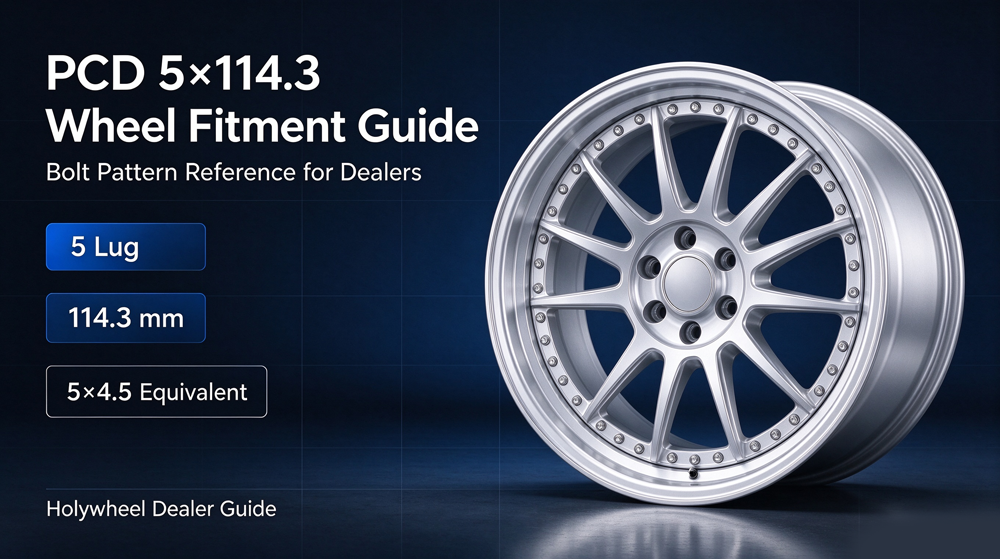
PCD 5×114.3 means five lug bolts arranged on a 114.3 mm (4.5-inch) bolt circle. It is one of the most widely used bolt patterns in the global aftermarket, covering major Japanese, American, and Korean nameplates. If you source alloy wheels in bulk, this PCD alone can address a large share of your dealer inquiries.
What Does 5×114.3 Actually Mean?
The designation breaks into two parts. The first number (5) is the lug count. The second number (114.3) is the diameter of the imaginary circle that passes through the center of all five bolt holes, measured in millimeters.
Some catalogs list this PCD as 5×4.5. That is the imperial equivalent. The bolt circle diameter is 4.5 inches, which converts to exactly 114.3 mm. Both terms refer to the same fitment, and you will see them used interchangeably in North American and Asian markets.
Dealers often ask whether 5×114.3 and 5×115 are interchangeable. They are not. A 0.7 mm difference in bolt circle diameter is enough to prevent proper hub engagement. Always match the exact PCD specification. Supplying wheels drilled for 5×114.3 to a customer with 5×115 hubs will result in fitment failures and returns.
Vehicles That Use PCD 5×114.3
This bolt pattern covers an extensive range of passenger vehicles across multiple OEMs. Below is the verified center bore data you need when matching wheels to vehicles. Center bore is critical because it determines whether the wheel centers properly on the hub without vibration.
| Vehicle Brand / Model | Center Bore (mm) | Typical Sizes | Notes |
|---|---|---|---|
| Honda (Civic, Accord, CR-V) | 64.1 | 16″ – 19″ | One of the highest-volume PCD matches |
| Toyota / Lexus (Camry, RAV4, IS) | 60.1 | 16″ – 20″ | Lexus IS uses same PCD, smaller bore |
| Nissan (Altima, Maxima, 370Z) | 66.1 | 17″ – 20″ | Consistent across most models |
| Mazda (Mazda3, CX-5, MX-5) | 67.1 | 16″ – 19″ | Shared bore with Mitsubishi |
| Mitsubishi (Lancer, Outlander) | 67.1 | 16″ – 18″ | Same center bore as Mazda |
| Subaru (WRX, BRZ, Forester) | 56.1 | 16″ – 18″ | Smallest center bore in this PCD group |
| Hyundai / Kia (Elantra, Sonata, K5) | 67.1 | 16″ – 19″ | Growing market share in aftermarket |
| Ford Mustang (2015+) | 70.5 | 17″ – 20″ | Pre-2015 models use different PCD |
| Dodge Charger / Challenger | 71.6 | 18″ – 22″ | Largest bore; popular in muscle car segment |
When stocking wheels for this PCD, the center bore range spans from 56.1 mm to 71.6 mm. Many aftermarket wheels are manufactured with a larger bore (e.g., 73.1 mm) and sold with hub rings sized to match. This approach reduces the number of unique SKUs you need to carry while still covering multiple vehicle brands.
Offset Range and Fitment Considerations
Offset (ET) is the distance between the wheel mounting surface and its centerline, measured in millimeters. For 5×114.3 applications, the most common offset range spans from ET35 to ET50, though this varies by vehicle and wheel width.
Here is a practical breakdown:
- ET35 – ET40: Typical for wider wheels (8.5″ – 10″) on performance and stance-oriented builds. The lower offset pushes the wheel outward, filling the fender. Common on Mustang, Charger, and modified Japanese platforms.
- ET40 – ET45: The sweet spot for most OEM-plus replacements. Works well on Honda, Toyota, Nissan, and Mazda applications with 7.5″ – 8.5″ widths.
- ET45 – ET50: Often found on higher-offset applications like Subaru and select Lexus models. Ensures the wheel sits tucked within the fender line.
As a dealer, offering wheels in the ET35-ET50 range with 5×114.3 PCD covers the vast majority of fitment requests you will receive. If you need custom offsets outside this range, confirm availability with your supplier before quoting the customer.
Key Fitment Checklist
Before confirming any wholesale order, verify these parameters against your customer’s vehicle list:
- PCD: 5×114.3 confirmed (not 5×115 or 5×112)
- Center bore: Matches or exceeds the vehicle hub diameter
- Offset: Within the vehicle’s acceptable range to avoid suspension or fender interference
- Lug seat type: Confirm whether the vehicle requires conical (60-degree), ball, or flat-seat lug nuts
- Wheel size: Diameter and width within the vehicle’s tire size compatibility range
Cast vs. Forged: What Dealers Should Stock
The 5×114.3 bolt pattern is popular across both economy and performance segments. Your product mix should reflect the demand profile of your dealer network.
| Factor | Cast Wheels | Forged Wheels |
|---|---|---|
| Price point | Lower, high margin at volume | Premium, higher per-unit margin |
| Weight | Standard | 20-30% lighter at same size |
| Typical buyer | Replacement market, fleet, general retail | Performance enthusiasts, tuning shops |
| MOQ | 100 pcs per design | From 4 pcs |
| Structural warranty | 2 years | 5 years |
| Custom finish | Available at MOQ | Available at MOQ |
For most dealers entering the 5×114.3 market, cast wheels represent the fastest path to revenue. The lower MOQ and broader price acceptance make it easier to move inventory. As your customer base develops performance-oriented demand, adding forged options allows you to capture higher margins without changing the PCD coverage.
Wholesale Notes
- MOQ – Stock items: From 20 pcs mixed sizes and finishes. Ideal for dealers testing the market or filling gaps in inventory.
- MOQ – Custom cast: 100 pcs per design. Includes custom finish, color, and packaging options.
- MOQ – Custom forged: From 4 pcs. Low barrier for shops that want exclusive forged designs.
- Lead time: Custom orders 30-45 days after deposit receipt.
- Container loading: Container loading optimized per size mix. Mixed container loading available to maximize your per-container unit count.
- Shipping port: FOB Nansha / Huangpu, Guangzhou, China.
- Quality assurance: Production partners certified to JWL and VIA standards. Cast wheels carry a 2-year structural warranty; forged wheels carry a 5-year structural warranty.
- Stock availability: 40,000+ wheels in stock. Standard items ship within 24 hours of order confirmation.