

Alloy Wheel Blog | Industry Insights & B2B Sourcing Guides | Holywheel
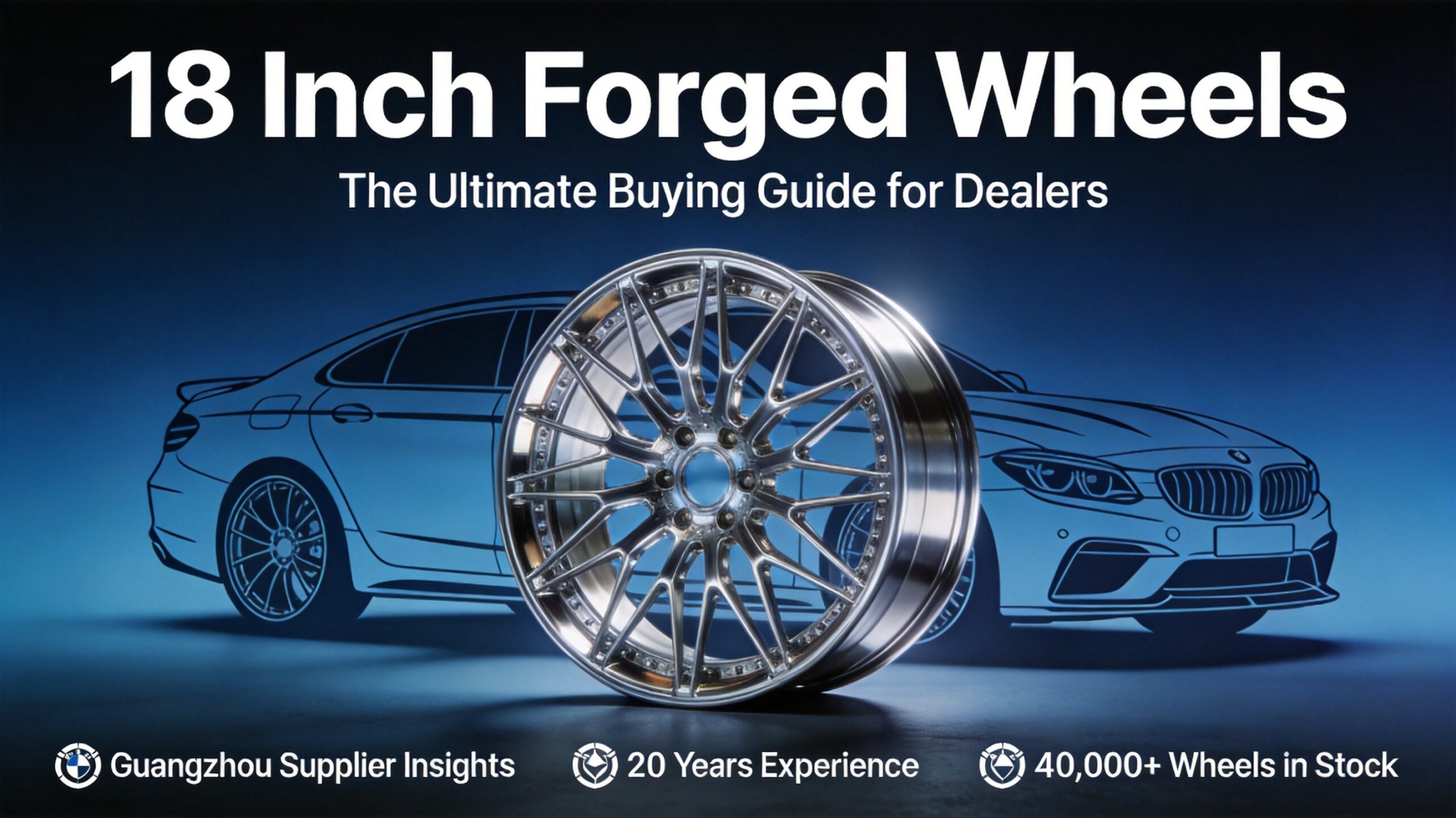
18 Inch Forged Wheels: The Ultimate Buying Guide for Dealers & Enthusiasts

By a 20-year wheel industry veteran — no fluff, just real talk.
Let me be straight with you. In my two decades selling wheels — from small bolt-on sets to full container loads for overseas distributors — 18 inch forged wheels have consistently been the single most profitable size in our catalog. Not 17s, not 20s. 18s. And I’m going to tell you exactly why, and how to stock them so they actually move.
If you’re a dealer, a tuner shop owner, or an enthusiast who’s tired of getting ripped off on flowery marketing copy — keep reading. This is the no-nonsense breakdown.
Why 18 Inch Forged Wheels Are the Golden Size
Here’s what I’ve seen over 20 years: the 18-inch sweet spot sits right between performance and practicality. Too small, and you lose brake clearance on modern performance cars. Too big, and ride quality suffers — plus you’re carrying inventory that only fits a handful of models.
18 inch forged wheels hit the middle perfectly. They clear big brake kits on BMW 3 Series, Mercedes C-Class, and Audi A4 platforms. They maintain enough sidewall to not rattle your teeth out on rough roads. And critically — they fit the widest range of vehicles in the premium segment.
For dealers, that means one size covers more cars. Fewer SKUs. Faster turnover. That’s why forged alloy wheels 18 inch variants are consistently our top-selling diameter — and I’ve seen the same pattern at every distributor I’ve worked with.
The demand isn’t slowing down either. Tesla Model 3 and Model Y owners are jumping on forged alloy wheels 18 inch as a weight-conscious upgrade over the heavy factory options. That’s a whole new customer base that didn’t exist ten years ago.
Forged vs. Cast: What Actually Matters
I get asked this daily. Let me cut through the noise.
Weight — The Real Performance Difference
A cast 18-inch wheel for a BMW 3 Series typically weighs 24-27 lbs. A comparable forged 18 inch forged wheel? 18-21 lbs. That’s a 4-6 lb savings per corner — rotating mass, not static weight. If you know anything about vehicle dynamics, you know rotating mass matters 3-4x more than unsprung weight.
Less rotating mass means faster acceleration, shorter braking distances, and — this is what enthusiasts actually feel — sharper steering response. The car feels lighter on its feet.
Strength — Forged Isn’t Just Marketing
Forging compresses aluminum under extreme pressure (typically 8,000-12,000 tons), which aligns the grain structure along the wheel’s contours. Cast wheels have random grain orientation — they’re inherently weaker at stress points.
In practical terms? A forged wheel can take a pothole hit at speed that would crack a cast wheel. For your customers who actually drive hard — canyon runners, track day guys, anyone on roads with surprise potholes — 18 inch forged wheels are the only responsible recommendation.
The Manufacturing Process — Briefly
Cast wheels: molten aluminum poured into a mold. Fast, cheap, limited structural integrity.
Forged wheels: a solid billet of 6061-T6 aluminum is heated and compressed into shape, then CNC-machined to final dimensions. More time, more cost, vastly superior product.
There’s a middle ground — flow-formed wheels — where the barrel is spun-formed after casting. Better than pure cast, not quite forged. I’ll cover those below because they’re a smart inventory play for certain price points.
6061-T6 Aluminum: The Material That Makes Forging Work
If you’re selling forged wheels, you need to know what 6061-T6 actually means — because your customers will ask, and if you can’t answer, you lose the sale.
6061 is the aluminum alloy grade. It’s part of the 6000-series, alloyed with magnesium and silicon. Here’s why it’s the standard for forged wheels:
- Tensile strength: 45,000 PSI (310 MPa) in T6 temper
- Yield strength: 40,000 PSI (276 MPa)
- Corrosion resistance: Excellent — critical for wheels exposed to road salt, brake dust, and weather
- Machinability: Outstanding for CNC operations — holds tight tolerances without micro-cracking
The “T6” refers to the heat treatment: solution heat-treated, then artificially aged. This is what gives the alloy its final mechanical properties.
I’ve seen some shops trying to cut costs with 6063 or 5052 alloys. Don’t. The strength difference isn’t worth the liability. 6061-T6 is the spec. Period. If a supplier tells you their wheels are “forged” but won’t disclose the alloy — walk away.
For the technical specs, I always point people to SAE International’s aluminum alloy standards — it’s the gold standard reference.
CNC Machining: Where Precision Meets Design Freedom
Here’s what separates a premium 18 inch forged wheel from a generic one: the CNC machining process.
After the forging press creates the rough shape, the wheel goes to a 5-axis CNC mill. This is where the final spoke geometry, barrel profile, mounting surface, and bolt pattern are cut. Tolerances are held to ±0.05mm — that’s five-hundredths of a millimeter.
What does this mean for your customers?
- Perfect hub-centric fitment — no vibration at highway speeds
- Precise offset and width — guaranteed clearance on OEM brake calipers and suspension components
- Consistent quality — every wheel in a set is identical, not “close enough”
The CNC process also enables designs that casting simply cannot produce. Complex concave profiles, undercut spoke edges, sharp crease lines — these are all CNC-exclusive features. If you’re offering custom forged wheels to customers who want something unique, CNC is non-negotiable.
Popular Fitments: What to Stock for Maximum Turnover
Here’s my honest stocking advice, based on what actually sells in the 18 inch forged wheels category:
BMW 3 Series (F30/G20) & 5 Series (G30)
Bolt pattern: 5×112 (G20/G30) or 5×120 (F30). CB: 66.5mm or 66.6mm. These cars eat up 18×8.5 ET35 and 18×9.5 ET38 fitments. The G20 3 Series is probably the single highest-volume car for aftermarket 18s in the premium segment.
Mercedes C-Class (W205/W206) & E-Class (W213)
5×112, CB 66.6mm. Popular fitments: 18×8 ET34, 18×8.5 ET35, 18×9 ET38. The C43 and E53 AMG variants are especially popular with wheel upgraders — owners want the look of the bigger AMG wheels without the harsh ride of 19s or 20s.
Audi A4 (B9) & A6 (C8)
5×112, CB 57.1mm (A4) or 66.6mm (A6). 18×8 ET40 and 18×8.5 ET38 are the go-to specs. Audi owners tend to be more design-conscious — they’ll pay premium for the right look.
Tesla Model 3 & Model Y
5×114.3, CB 64.1mm. This is the growth category. 18×8.5 ET35 works perfectly on both. Model 3 Performance and Model Y owners are actively seeking lighter wheels to recover range — a set of 18 inch forged wheels that’s 5 lbs lighter per corner can recover 8-12 miles of estimated range. That’s a real selling point.
When stocking, prioritize these four platforms. They represent 70%+ of the premium aftermarket wheel market in the 18-inch segment.
18 Inch Forged Wheel Styles: What Customers Are Actually Buying
Flow-Formed 18s — The Smart Mid-Range Play
Flow-formed (also called rotary-forged) wheels are your bread-and-butter volume seller. They offer 80% of forged performance at 50% of forged price. The barrel is spin-formed under pressure, which aligns grain structure in the barrel area — the highest-stress zone.
For customers who want the look and most of the benefits but aren’t ready to spend $800+ per wheel, flow-formed forged alloy wheels 18 inch options are your conversion tool. Once they feel the weight difference, they’re often back for a full forged set on their next car.
Multi-Piece Forged — The High-Margin Premium Tier
Two-piece and three-piece forged wheels are where the serious money is. Separable centers and barrels mean near-infinite fitment customization — any offset, any width, any bolt pattern. For the customer who has a widebody kit, a lowered suspension, or a truly unique build, multi-piece forged is the only answer.
These are also the wheels that pair best with forged wheels for luxury cars — the Rolls-Royce, Bentley, and high-spec Porsche crowd who want bespoke fitments. Margins are higher, volumes lower, but the customer loyalty is intense.
Concave Forged — The Visual Statement
Deep concave profiles are what makes wheels look expensive on the internet. The concave design creates visual depth — spokes appear to scoop inward toward the hub. On an 18-inch diameter, you can achieve moderate concave without compromising spoke strength, making it the ideal balance.
Surface Finishes: Matching Trends to Your Market
Your finish options on 18 inch forged wheels directly impact your customer demographic:
| Finish | Who Buys It | Margin |
|---|---|---|
| Brushed Silver | OEM+ crowd, conservative buyers | Standard |
| Polished Chrome | Classic luxury, show cars | High |
| Matte Black | Tuners, Tesla owners, street look | Standard |
| Gunmetal (Dark Grey) | Enthusiasts, European car owners | High |
| Bronze | JDM-adjacent, track enthusiasts | High |
| Custom Paint | Bespoke requests | Highest |
My advice: stock brushed silver and matte black as your base inventory. Gunmetal as your premium option. Chrome and bronze as special-order items.
The finishes that move fastest right now are satin gunmetal and matte black with a machined-face accent. That contrast — dark barrel, bright machined highlights — is the dominant trend in the aftermarket space for 2024-2025.
Wholesale Pricing & Dealer Strategy
Let’s talk money. Here’s the pricing reality for 18 inch forged wheels at wholesale:
Pricing Tiers (Per Wheel, FOB)
- Flow-formed: $85-140 per wheel
- Single-piece forged: $180-300 per wheel
- Multi-piece forged: $350-600+ per wheel
Your retail markup should be 2.2-3x on forged, 2-2.5x on flow-formed. The forged segment actually supports higher multipliers because customers doing the research understand the value.
Volume Discounts & MOQ
Typical MOQ for a new dealer relationship: 20-40 pieces. At that level, expect pricing at the higher end of the range above. Once you’re moving 100+ pieces per order consistently, negotiate aggressively — even $10-15 per wheel savings translates to serious margin at volume.
Profit Per Set
A typical forged 18-inch set (4 wheels) retails for $1,200-2,400 depending on style. Your wholesale cost is $720-1,200. After shipping, duties, and overhead, you’re looking at $300-800 gross profit per set. For multi-piece forged, it’s higher — $600-1,500 per set is achievable.
Stocking Strategy
Start lean. Stock your top 3 styles in the 3 most popular fitments (5×112, 5×120, 5×114.3) in standard offsets. Total initial inventory: 60-80 wheels. Once you see which styles turn fastest, double down on those and expand offset options.
Dealer Insights: Avoiding the Common Mistakes
After watching hundreds of dealers succeed and fail in this space, here are the mistakes I see repeatedly:
- Over-stocking niche fitments — 5×100 and 5×110 are valid platforms (Subaru, some Volvos), but they move slowly. Stick to the big three until you have consistent cash flow.
- Under-investing in product knowledge — If your sales staff can’t explain why 6061-T6 matters, or what offset means, you’re losing sales to shops that can. Train your team.
- Ignoring the Tesla market — Model 3 and Y owners are tech-savvy, research-heavy buyers. If you don’t have 18-inch options for them with specific weight and range recovery data, you’re leaving money on the table.
- Pricing too low — Forged wheels are a premium product. If your pricing screams “cheap,” customers assume quality issues. Price for value, justify it with knowledge.
Quality Standards & Certifications
When sourcing 18 inch forged wheels, demand documentation. Any reputable supplier should provide:
- Material test reports (confirming 6061-T6 specs)
- Dimensional inspection reports (verifying bolt pattern, CB, offset, width tolerances)
- JWL/VIA certification for Japanese market compliance
- TUV documentation for European market
The SEMA organization maintains guidelines and standards for aftermarket wheels that every serious supplier should follow. Stay current with their publications.
FAQ: Common Questions About 18 Inch Forged Wheels
Are 18 inch forged wheels worth the premium over cast?
Absolutely. The weight savings alone (4-6 lbs per wheel) transform how a car drives. Add the strength advantage and the design possibilities from CNC machining, and the answer is a clear yes. For daily-driven premium cars, forged is the smart upgrade.
What’s the difference between flow-formed and fully forged?
Flow-formed wheels start as castings, then the barrel is spun under heat and pressure to align grain structure. Fully forged wheels start as a solid billet pressed under 8,000+ tons. Flow-formed gives you ~80% of the performance at ~50% of the cost. Fully forged is the top tier — lighter, stronger, more design flexibility.
Can 18 inch forged wheels fit Tesla Model 3 and Model Y?
Yes. The 5×114.3 bolt pattern and 64.1mm center bore are well-supported. Popular fitments include 18×8.5 ET35. Lighter forged wheels recover estimated range on both platforms — typically 8-12 miles depending on tire choice and driving style.
What’s the typical lead time for wholesale orders?
Standard designs in stock: 7-15 days for production and shipment. Custom offsets or finishes: 30-45 days. Multi-piece forged wheels with bespoke specifications: 45-60 days. Always confirm timelines with your supplier before promising delivery dates to customers.
How do I choose between brushed and matte finishes for my inventory?
Stock both. Brushed silver appeals to OEM+ buyers and luxury car owners who want a subtle upgrade. Matte black is the enthusiast and tuner favorite. Both turn over quickly. Gunmetal is your third option — it commands premium pricing and appeals to the design-conscious European car crowd.
The Bottom Line
After 20 years in this industry, I’ll tell you what I know for certain: 18 inch forged wheels are the smartest inventory investment a dealer can make in the premium aftermarket segment. The demand is consistent, the margins are healthy, and the customer base is growing every year as new platforms (Tesla, electric luxury sedans) come online.
Whether you’re stocking flow-formed for volume sales or multi-piece forged for the premium tier, the key is starting smart, knowing your fitments, and building supplier relationships that give you competitive pricing and reliable quality.
Ready to talk about stocking 18 inch forged wheels for your business?
Drop me a line at info@holywheel.com. Whether you need fitment data, pricing on specific styles, or advice on your first order — I’ll give you a straight answer. No sales pitch, just 20 years of wheel knowledge.
Guangzhou-based supply. 40,000+ wheels in stock. Shipping worldwide.